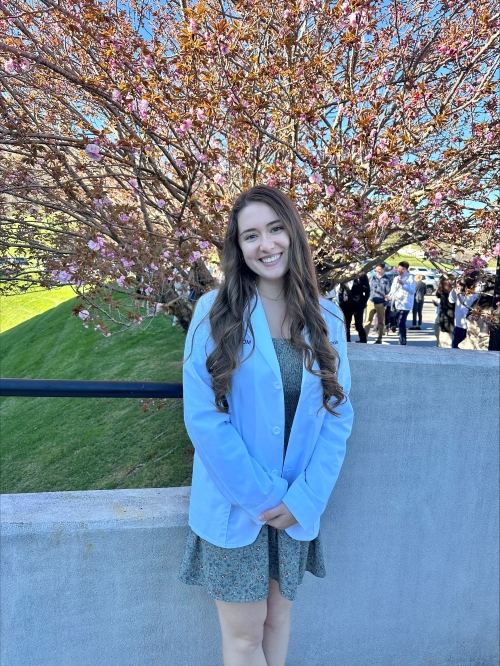
As the American Heart Association recognizes CPR and AED Awareness this month, a Lincoln Memorial University-DeBusk College of Osteopathic Medicine (LMU-DCOM) student is reflecting on how those skills helped her save a life across the world last winter.
Brianna Mastroianni, who was a second-year medical student (OMS-II) at the time, had just arrived in Dublin, Ireland, after an overnight flight from Boston. She and a friend were feeling groggy but were preparing for the first leg of a multi-country trip across Europe.
“I had just arrived in Dublin after a 7-hour overnight flight from Boston. My best friend and I were on the first leg of our trip to Germany, Brussels, and the Netherlands. It was 4:30 a.m. local time, and, of course, she was making fun of me for cracking open my first aid book the moment we sat down,” Mastroianni recalled. “The airport was nearly empty, with only a few flight attendants passing by and no gate agents in sight. I was thinking about how I might want to have a coffee soon to adjust to the time change.”
As she reviewed her study material while waiting at the gate, her friend noticed commotion nearby.
“Several people were gathering by a gate headed for Paris,” she said. “A moment later, she came back and said, ‘Bri, you need to go over there.’”
Mastroianni walked over and found a man lying unresponsive on the ground, surrounded by bystanders unsure how to respond.
“I ran over, ‘I'm a medical student, how can I help?’ Everyone immediately took a step back and put their hands up: ‘All yours,’” she remembered them telling her.
She quickly assessed the patient. “I felt the radial pulse on his right wrist. Nothing. His skin was a deep violet color, and he was attempting to take breaths with agonal respirations.”
Recognizing the urgency, she began directing those nearby.
“‘Why hasn't CPR been started?’
‘He is breathing’
‘Those are not breaths. You, start compressions.’”
Within seconds, she coordinated efforts to begin CPR, call emergency services and locate an automated external defibrillator (AED).
“‘Is someone getting an AED?’
‘There isn't one, we looked.’
‘Go find one. We are at an international airport. There is an AED.’”
Drawing on recent hands-on training at LMU-DCOM, Mastroianni took over compressions.
“I could tell he wasn't trained in CPR, so I took over. I performed 30 compressions to 2 breaths,” she said. “We didn't have a bag-valve mask available, but we did have the face mask attachment with the filter.”
When the AED arrived, she continued leading the effort. “I resumed compressions for another few rounds before we shocked him again. We shocked him a total of 3 times.”
Throughout the response, she remained focused solely on the patient.
“My wool coat and thick scarf were still wrapped around me, but my adrenaline kept me from noticing anything except the patient,” she said.
Emergency responders soon arrived and confirmed the patient’s condition.
“He was in VFib [Ventricular Fibrillation]. This was not necessarily a good sign, but it brought me hope knowing that this can be solved with defibrillation,” she said.
A lesson from her LMU-DCOM training proved critical in confirming recovery.
“A few months prior, I had asked a (silly) question: ‘How do you know you truly have a pulse back…?’” she said. “Not only will I never forget that painful moment, but trust me, it came in handy in Dublin.”
After 20 to 30 minutes of sustained effort, the patient regained a pulse.
“We finally got a pulse back. I confirmed it on the carotid pulse (and radial just to be sure),” she said. “My friend who had stayed back with our bags came over to tell me that we were about to miss our flight. I asked the paramedics if they needed any other assistance, reminding them that his belongings were on the seat at his gate, and I left the scene to board my plane.”
As she prepared to board her next flight, she received an update that confirmed the outcome.
“[A flight attendant] thanked me again and informed me that moments after I walked away, they loaded the man onto a stretcher and he had woken up,” she said, remembering her relief. “He was alive and talking with the paramedics.”
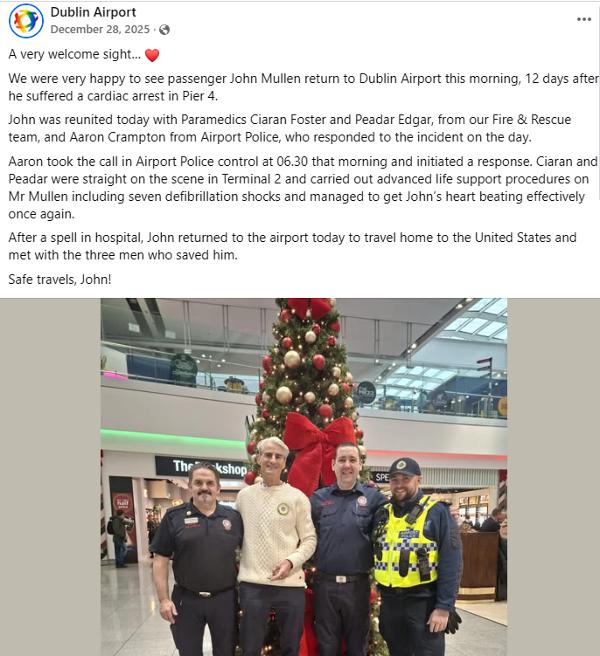 A later update shared by Dublin Airport confirmed the man survived and flew home 12 days later.
For Mastroianni, the experience reinforced both her training and her calling.
“This moment will stay with me for a long time,” she said. “It reaffirmed how much I have learned and grown throughout medical school, and how comfortable I feel in high stress situations.”
She credited LMU-DCOM faculty and training experiences for preparing her to act.
“I want to thank Dr. Yonts, along with Dr. Bonn, Dr. DeFranco, Dr. Darter, and all the EPC professors that assisted in our hands-on skill trainings and SIM labs. Without your training, and the ‘silly questions’, this situation may not have had the outcome that it did.”
In a quiet airport thousands of miles from campus, an LMU-DCOM student stepped forward and helped save a life. It is powerful reminder, during CPR and AED Awareness Month, of the impact of training, preparation and the willingness to act.
About LMU-DCOM
The DeBusk College of Osteopathic Medicine is located on the campus of Lincoln Memorial University in Harrogate, Tennessee, at LMU-Knoxville in Knoxville, Tennessee, and at LMU Orange Park in Orange Park, Florida. LMU-DCOM is an integral part of LMU’s values-based learning community and is dedicated to preparing the next generation of osteopathic physicians to provide health care in the often-underserved region of Appalachia and beyond. For more information about LMU-DCOM, call 1.800.325.0900, ext. 7082, email dcom@LMUnet.edu, or visit us online at http://med.LMUnet.edu.
