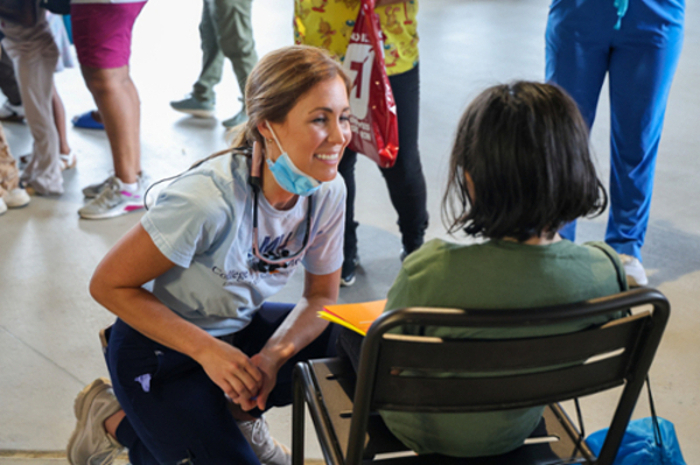
At Lincoln Memorial University-College of Dental Medicine (LMU-CDM), the path to becoming a dentist does not end at the clinic door. It extends into rural health centers, school gymnasiums, and community events across East Tennessee, where access to care is limited and the need is immediate.
In Tennessee, 86 of 95 counties are designated dental shortage areas. That statistic shapes both the mission of the school and the experience of its students. For many, it becomes clear not in a lecture hall, but in the field.
“You don’t really understand how important it is to get out into the community until you’re actually out there,” said Waylon Reynolds, a fourth-year dental student. “It makes a difference, and it makes us better clinicians.”
At LMU-CDM, that exposure is built into the curriculum through two primary avenues: required volunteer service and the community-based clinical education program.
Students complete 30 hours of community service each semester, participating in outreach efforts that range from distributing dental supplies to providing oral health education. For first-year student Shiv Patel, those experiences reflect the core of the profession.
“As dentists, we’re here to provide to our community,” Patel said. “Community service is about giving back and donating our time.”
While volunteer work introduces students to community needs, the school’s community-based clinical education program offers a deeper level of immersion.
Dr. Wayne Cottam, associate professor and director of the community-based clinical education program, said its purpose is to move students beyond the controlled environment of the dental school and into real-world practice settings.
Cottam is candid about what students gain and said it is not always what they expect.
“A lot of students think the best thing they can get out of this is more clinical experience — lots of fillings, lots of extractions,” he said. “But the biggest thing they get is their confidence. They come back realizing they can do a lot more than they thought they could. Once they get out of the dental school setting, which tends to be restricting, they really blossom.”
Through multi-week rotations, students are placed in private practices, nonprofit clinics, federally qualified health centers and corporate offices. Many are in rural and underserved areas throughout East Tennessee and Appalachia. In these settings, students treat patients, assist with a range of procedures and experience the day-to-day realities of clinical care.
While speaking about the reasons behind these placements, Cottam emphasized the importance of empathy and understanding, two factors that LMU-CDM students are taught are just as important as their medical knowledge.
“One of the main goals is for students to understand those populations and the barriers they encounter in obtaining care,” he said.
Those barriers often include cost, transportation and limited access to dental education.
For third-year student Michael Yates, addressing those gaps is a critical part of the work.
“There’s a real need for education in our community,” Yates said. “When we go out, we’re not just treating people. We’re teaching them.”
That education can take many forms, from explaining proper brushing techniques to helping patients understand the long-term impact of oral health.
Riley Barnett, a dental hygiene student, recalled an outreach event at Neyland Stadium where students provided dental supplies to children in need.
“We were able to give them products,” Barnett said. “But more importantly, we taught them how to take care of their teeth, and that’s something they can keep with them.”
In communities where access to care remains limited, those moments can have lasting effects.
That empathy, Cottam said, is not taught in a lecture. It’s modeled. The preceptors who host students at these sites have often spent years, sometimes entire careers, serving the same communities.
“There’s the technical ability of actually doing dentistry, but then there’s also the empathetic care, the dedication to a community,” Cottam said. “Students learn that from preceptors who have been there for a long time and are there because they really want to be, because they really care about those populations.”
Courtney Radelescu, a fourth-year student, said that kind of modeling has stayed with her.
“Everyone has a story, and everyone deserves the same quality care,” she said. “It’s helped me become more empathetic as a provider.”
Cottam said that growth is one of the program’s most important outcomes. In some cases, the experience reshapes a student’s entire career path. Cottom has seen it happen repeatedly across LMU and at other schools where he has built similar programs
“Students come out of a rural clinic or a community health center and say, ‘Going to a rural area wasn’t anything I ever thought I would do,’” he said. “But because of this experience, they now feel like they want to dedicate their career to that. It changes their trajectory and puts them in a position to really benefit those populations in a way that fulfills LMU’s mission long term.”
At LMU, service is not treated as an extracurricular activity but as the connective tissue of a dental education — the thing that turns a competent clinician into one who understands why the work matters.
