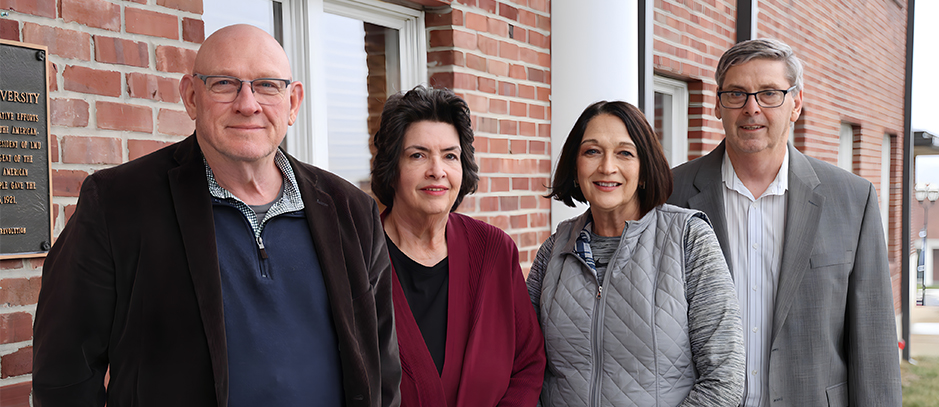
Left to right: David Laws, Helen Bailey, Sherry Pearman, and Conrad Daniels represent a total of nearly 200 years of service to Lincoln Memorial University
As Lincoln Memorial University (LMU) observes Founders Day on Feb. 12, the university spotlights staff members Conrad Daniels, Sherry Pearman, Helen Bailey and David Laws, whose careers reflect LMU’s mission across five decades. Their stories are interwoven with the institution’s own evolution.
“The Thread That Runs So True,” a novel by LMU alumnus Jesse Stuart ’29, has long symbolized the university’s enduring values. Daniels, Pearman, Bailey and Laws are among the longtime employees whose work recruiting students, guiding finances, safeguarding academic records, and building and maintaining the campus has shaped LMU’s modern era. Together, they represent the thread connecting LMU’s past to its present.
When Conrad Daniels arrived as a freshman in fall 1971, LMU looked far different from the university students know today.
Enrollment hovered around 500 undergraduates. Graduate programs did not yet exist. West Hall marked the campus boundary, and where Tex Turner Arena now stands, Daniels recalls a two-acre tomato patch tended by students. Faculty and staff could gather in a single room upstairs in the campus center.
“It wasn’t the ‘good old days,’” Daniels said. “For the university, those days were tough. Growing enrollment wasn’t about hitting goals. It was about survival.”
That urgency shaped Daniels’ early career. He joined LMU in January 1975 as an admissions counselor when the admissions office was operated by an Atlanta-based firm. Recruitment was entirely manual.
“Paper files. No computers,” Daniels said. “We’d visit two or three high schools a day, and in the summer, we’d make home visits to help students and talk to parents.”
When LMU assumed control of admissions in 1979, Daniels was named director. He helped launch the Lincoln Ambassadors program and guided LMU into membership with Oak Ridge Associated Universities.
“When I asked about applying, I was told I was wasting my time,” Daniels said. “I submitted the application anyway, and to my surprise, we were accepted. We’re still a member today.”
He credits former LMU president Gary Burchett as a formative influence.
“For the first several years I worked for LMU, I didn’t even know I had a budget or a supervisor,” Daniels said. “If I needed something for the office, Dr. Burchett approved it.”
Of his many memories, one stands above the rest: watching his son graduate summa cum laude.
“That one meant the most,” Daniels said.
While Daniels focused on bringing students to campus, others ensured the university’s financial footing remained steady. In January 1978, Sherry Pearman joined LMU as a student accounts clerk in the Business Office, one of just four employees managing responsibilities that today span multiple departments.
“We handled accounts receivable and payable, employee hiring, payroll, insurance, everything,” Pearman said.
The work was demanding but personal.
“You knew each employee,” she said.
Over more than four decades, Pearman watched LMU expand in enrollment, academic offerings and locations. Yet for her, progress was measured most clearly in student success.
“Seeing students come to the university looking for guidance and walking out with college degrees,” Pearman said. “That’s what I’m most proud of.”
She credits colleagues Roy Floyd and Pete Vires as lasting influences. Asked to summarize her LMU career in a phrase, she laughed.
“Where has the time gone?” she said.
As enrollment and operations grew more complex, so did the systems needed to manage academic records. Helen Bailey began work in June 1980 as director of academic systems and records at a time when nearly everything was done by hand.
“There was no technology like we have today,” Bailey said. “Communication was either in person, by phone, or using a typewriter.”
One of her earliest tasks was helping transition LMU from manual registration to computer-based systems.
“With assistance from others, LMU was able to use this new technology for fall 1980 registration,” Bailey said. “I felt like that was an accomplishment in offering better service.”
Over the next four decades, she witnessed enrollment growth, new programs, expanded facilities and additional instructional sites, all while safeguarding the accuracy of the records that define a student’s academic journey.
“What a journey,” Bailey said.
As academic systems modernized, the physical campus was also transforming. David Laws arrived more than four decades ago and would go on to serve in roles spanning information systems, campus operations, properties and infrastructure management, giving him a front-row seat to LMU’s physical expansion.
In his early years, the campus was smaller and growth came gradually, often requiring creative problem-solving and careful stewardship of limited resources. Each building project or system upgrade represented both opportunity and responsibility.
Over time, Laws oversaw infrastructure improvements that supported new academic programs, enrollment growth and off-campus instructional sites, ensuring that the university’s facilities kept pace with its mission.
Now vice president of Facilities Planning, Management and Safety Services, Laws continues to focus on sustainable growth and safety.
“You don’t always notice facilities when they’re working the way they should,” Laws said. “But every classroom, lab, residence hall and pathway matters.”
Looking back, he sees his career as part of a broader continuum.
“I’ve been fortunate to work alongside dedicated people who cared deeply about this university,” Laws said. “Watching the campus grow and knowing the work helped future generations has been meaningful.”
Though their roles differed, Daniels, Pearman, Bailey and Laws witnessed LMU’s growth from a close-knit campus to a comprehensive university serving students across disciplines and regions. Through decades of change, the mission endured.
