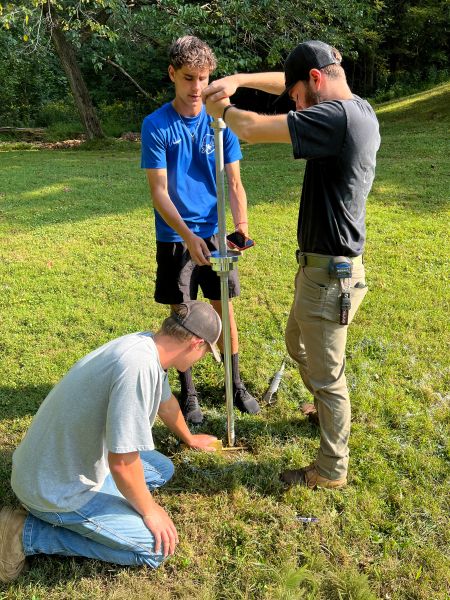
Before a new building ever rises above ground, civil engineers have to get their hands dirty. That’s exactly what students in the engineering program at Lincoln Memorial University (LMU) did in a recent hands-on geotechnical project that gave them a taste of real-world engineering from start to finish.
“This project was designed to give students a realistic look at the kind of investigative work that takes place long before construction begins,” said Tracy Grijalva. “They weren’t just learning about soil mechanics in theory. They were applying it in the field, analyzing real data, and making recommendations the same way they would in a professional setting.”
This assignment was not a worksheet or a one-day lab. Students were asked to act as geotechnical consultants responding to a construction Request for Proposals (RFP) for a 6,000-square-foot, single-story building with a steel frame and masonry walls. They were given real-world numbers about the building’s weight and foundation needs. The information reflected the kind of information engineers rely on to make safe and practical design decisions.
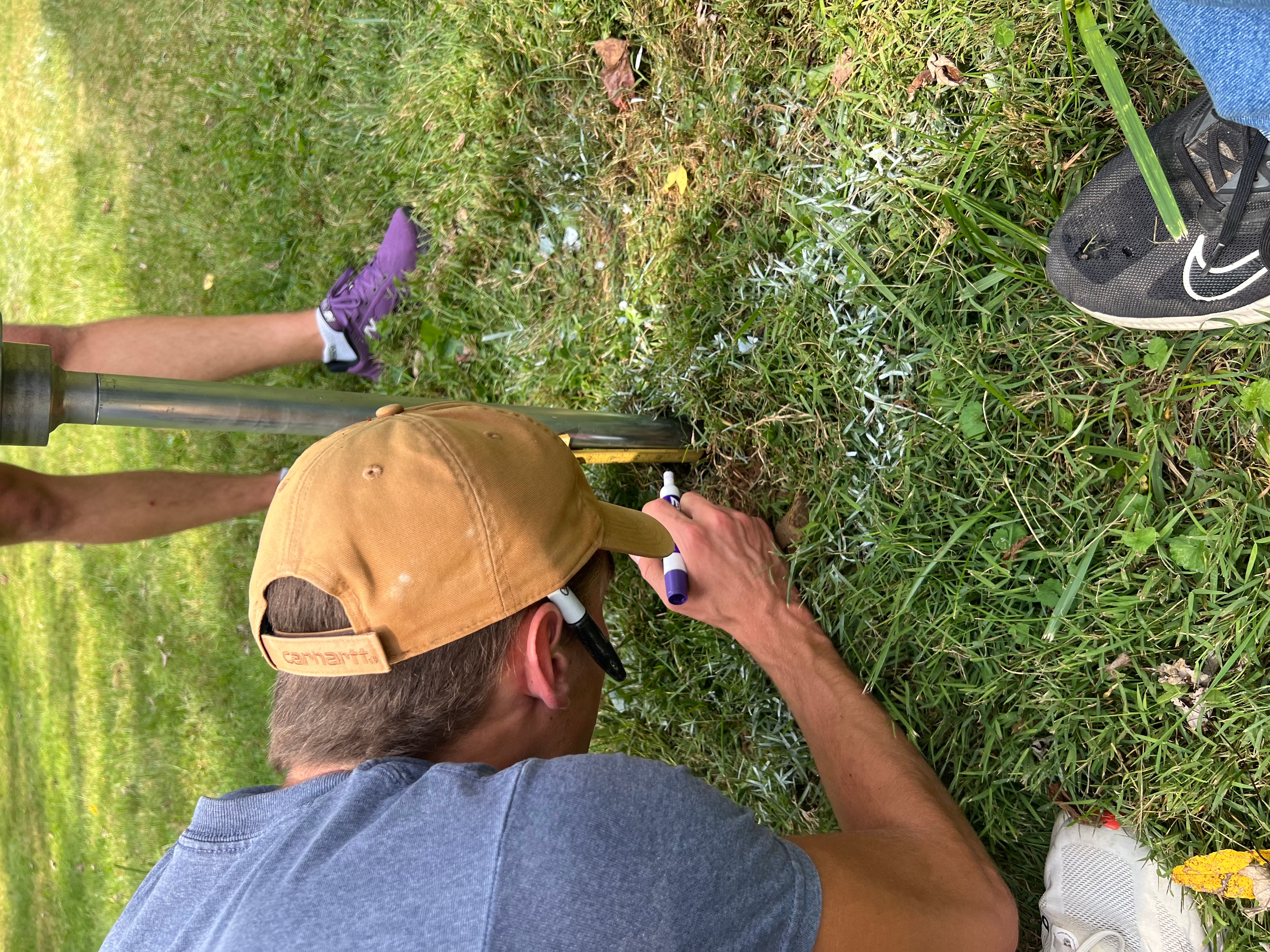 Students used hand auger borings to collect soil samples. They logged the boreholes performing visual classifications to note variations in texture, color, and moisture content. Through this hands-on process, they were able to see and feel the soil characteristics to compare with what they had been learning in class.
“They quickly realized the ground doesn’t always behave the way you expect,” said Grijalva. “Engineering isn’t just formulas. It’s interpreting imperfect information and making solid recommendations anyway.”
Back in the soils lab, students conducted several standard classification tests on the soil they collected. They performed sieve and hydrometer analyses to determine the particle size distribution and determined the Atterberg limits to assess the soil’s plasticity. Along with the moisture content data, they were able to classify the soil and develop practical recommendations for foundation depth, footing width, and site preparation.
All of this culminated in a professional-style geotechnical report, complete with maps, field notes, lab results, and actionable guidance that mirrors what a consulting engineering firm would produce.
“Projects like this challenge students to think critically, collaborate as a team, and communicate technical findings clearly,” said Dr. Ryan Overton, dean of the LMU School of Engineering. “It’s about giving them the opportunity to apply what they’ve learned in the classroom in a way that reflects real engineering practice.”
Through this project, LMU civil engineering students gained more than technical knowledge. They strengthened teamwork, problem-solving, technical writing, and hands-on field and lab skills. By stepping into a real-world consulting role, they are gaining the confidence and experience they need to succeed in internships and early-career roles in civil and geotechnical engineering.
For more information about the LMU School of Engineering, visit lmunet.edu/school-of-engineering/ or contact Overton at Ryan.Overton@LMUnet.edu.
Lincoln Memorial University is a values-based learning community dedicated to providing educational experiences in the liberal arts and professional studies. The university’s main campus is located in Harrogate, Tennessee. For more information about undergraduate and graduate programs, contact the Office of Admissions at 423-869-6280 or email admissions@lmunet.edu.
